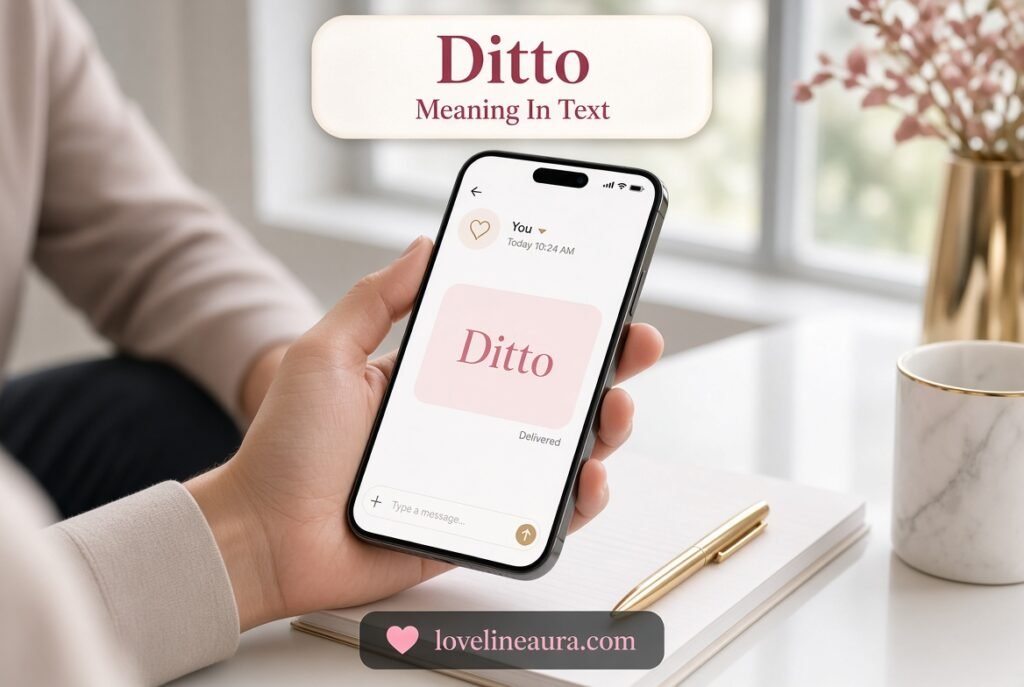

If you’re searching for ditto meaning in text, it simply shows agreement without repeating everything. The ditto meaning is closely related to same, me too, I agree, and same here. In ditto in texting, people use this texting expression as a compact response.
It works especially well in casual chats, modern conversations, and online communication. Understanding what does ditto mean also requires looking at meaning in context. This established English word has historical roots, yet remains useful in digital communication today.
Whether you see it in Instagram DMs, WhatsApp messages, TikTok comments, or Reddit, context helps explain its intended meaning. This guide explores the ditto definition, word usage, appropriate situations, and real examples.
Also Read This: ISK Meaning in Text: What It Means, How to Use It, and How to Understand It
What Does “Ditto” Mean in Text?
The ditto meaning in text is usually straightforward. When you send “ditto,” you’re saying that the previous statement also describes you or represents your opinion.
Depending on the conversation, it can mean:
- Same here
- Me too
- I agree
- I feel the same
- Likewise
- The same applies to me
- I have the same experience
- I share that opinion
The exact interpretation comes from the message immediately before it.
Ditto Meaning in Simple Words
Think of ditto as a verbal copy-and-paste button.
Someone makes a statement. Instead of repeating it word for word, you signal that their statement applies to you too.
For example:
A: “I could really use a vacation.”
B: “Ditto.”
That means:
“I could really use a vacation too.”
It can also show agreement with an opinion:
A: “That was the best movie we watched this year.”
B: “Ditto.”
Here, the response means:
“I agree. I also think it was the best movie we watched this year.”
What Does Someone Mean When They Text “Ditto”?
Most of the time, there’s no hidden code behind it. The person simply wants to mirror your previous statement.
However, tone can slightly change the feeling.
A warm conversation might make “ditto ❤️” sound affectionate. A quick “ditto” after a long emotional message could feel more detached because it gives little additional detail.
Context does the heavy lifting.
Why People Say Ditto Instead of Repeating Themselves
Digital conversations reward brevity. You don’t always need to type an entire sentence when one word can carry the same meaning.
Compare these responses:
“I feel exactly the same way about that.”
“Same.”
“Me too.”
“Ditto.”
All four communicate agreement, although they carry slightly different tones.
Ditto works especially well when the previous statement is clear enough that repeating it would feel unnecessary.
Real Texting Examples With Ditto
Example 1: Shared feeling
A: “I’m so ready for the weekend.”
B: “Ditto.”
Meaning: B is also ready for the weekend.
Example 2: Shared opinion
A: “That restaurant has the best burgers.”
B: “Ditto. Nothing else comes close.”
Here, B agrees and adds a little extra enthusiasm.
Example 3: Shared experience
A: “I barely slept last night.”
B: “Ditto.”
B means they also barely slept.
Example 4: Agreement
A: “We should leave before traffic gets worse.”
B: “Ditto.”
B agrees with the plan.
Example 5: Affection
A: “Miss you already.”
B: “Ditto ❤️”
Here, ditto means “I miss you too.”
Ditto Meaning in Texting and Online Chat
The ditto meaning in texting depends mainly on what came immediately before it.
Unlike many modern abbreviations, the word doesn’t require a special slang dictionary to understand. Its ordinary dictionary meaning already explains its texting use.
Oxford describes ditto as an informal word used instead of repeating a word or phrase and also as a way to express agreement or the same feeling.
How People Use Ditto in Conversations
People use ditto when they want to mirror a statement.
Common contexts include:
- Agreeing with an opinion
- Sharing the same emotion
- Confirming a preference
- Describing the same experience
- Agreeing with a plan
- Returning a compliment
- Expressing mutual affection
- Avoiding repetitive wording
For example:
A: “Coffee is basically my morning survival kit.”
B: “Ditto.”
The reply feels casual and slightly playful.
Common Situations Where People Use Ditto
You’ll usually understand ditto immediately when the previous message contains something that could logically apply to both people.
Shared preference
“I love rainy evenings.”
“Ditto.”
Shared problem
“My laptop is acting weird today.”
“Ditto.”
Shared excitement
“I can’t wait for the concert.”
“Ditto!”
Shared opinion
“That ending was disappointing.”
“Ditto.”
Shared emotion
“I’m nervous about tomorrow.”
“Ditto.”
The key is simple: the second person is borrowing the meaning of the first person’s statement.
Ditto Is Not the Same as WYLL
These two terms can appear in the same general search space because both occur in online conversations. Their meanings, however, have nothing in common.
Ditto means “same,” “me too,” or “I agree.”
WYLL stands for “what you look like” and is commonly used to ask someone about their appearance or request a photo.
| Term | Meaning | Purpose |
| Ditto | Same as what was said | Agreement |
| WYLL | What you look like | Asking about appearance |
For example:
A: “I love this place.”
B: “Ditto.”
Compare that with:
A: “We’ve been chatting for a while. WYLL?”
B: “I’m wearing a blue hoodie.”
One expresses agreement. The other asks for information about appearance.
Ditto and Gen Z Slang Culture
Gen Z communication often favors short, context-heavy expressions. Yet that doesn’t mean every useful word must be newly invented.
Ditto is an interesting example of an older word fitting neatly into modern digital communication.
It does the same thing that many newer expressions do: compresses a longer thought into a tiny response.
Compare:
“I completely understand and feel exactly the same way.”
with:
“Ditto.”
The second version is much shorter.
However, ditto doesn’t automatically qualify as Gen Z slang. It’s better described as an established informal English word that can still function naturally in contemporary texting.
That distinction matters because online language changes quickly. Research into slang has found that meaning can vary across communities and contexts, which makes surrounding conversation especially important when interpreting short expressions.
How to Use “Ditto” Naturally in Text
Using ditto well isn’t difficult. The trick is choosing situations where the previous statement clearly applies to you.
Match the Tone of the Conversation
If someone is writing formally, “ditto” might feel too casual.
For example:
“Thank you for your assistance.”
“Likewise.”
sounds more natural than:
“Thank you for your assistance.”
“Ditto.”
With friends, however, “ditto” can fit perfectly.
Use Ditto When the Previous Statement Clearly Applies to You
Good:
“I’m exhausted.”
“Ditto.”
Less clear:
“I’ve been thinking about what happened yesterday.”
“Ditto.”
The second example leaves the reader wondering what exactly you share. A more specific response would communicate better.
Avoid Using Ditto When More Explanation Is Needed
Imagine a friend says:
“I’m worried about the decision we made.”
Replying “ditto” shows that you share the concern, but it doesn’t offer much support.
A better response could be:
“Ditto. I’m wondering if we should talk it through again.”
The short reply establishes common ground. The second sentence adds substance.
Know When “Same” or “Me Too” Sounds More Natural
If you’re unsure, “same” or “me too” usually works in casual texting.
Use ditto when you want a slightly playful, concise, or deliberately emphatic version of “same.”
Keep the Context Clear
The strongest one-word responses depend on an obvious previous statement.
Think of ditto like a shortcut on a road. It saves distance only when everyone knows where the road leads.
Common Mistakes When Using “Ditto”
A few mistakes can make the word sound awkward.
Treating Ditto Like an Acronym
Don’t invent a “full form” for ditto. It isn’t an abbreviation.
Using Ditto Without a Clear Previous Statement
A standalone “ditto” can confuse people if they don’t know what you’re referring to.
Assuming Ditto Always Sounds Casual
Although people commonly use it informally, the word itself has a long history in standard English.
Confusing Agreement With a Different Meaning
Ditto doesn’t normally mean “I understand,” “okay,” or “yes” in every situation.
It specifically points back to something already stated.
Using Ditto When a More Specific Reply Is Better
If someone shares something emotional, don’t rely on one word when they need a thoughtful response.
For instance:
“I’m really struggling today.”
“Ditto” says you feel the same, but it doesn’t acknowledge the seriousness of the statement. A warmer response might be:
“I’m struggling too. Want to talk about it?”
That small addition can completely change the tone.
Ditto Meaning in Text: Quick Reference Table
| Question | Answer |
| What does ditto mean in text? | Same, me too, or I agree |
| Is ditto an acronym? | No |
| Does ditto have a full form? | No |
| Is ditto slang? | It’s an established informal English word rather than a newly created texting abbreviation |
| Can ditto mean “same here”? | Yes |
| Can ditto show agreement? | Yes |
| Can ditto be romantic? | Yes, depending on context |
| What is the closest alternative? | Same, me too, or same here |
| What does WYLL mean? | “What You Look Like,” which is unrelated to ditto |
| Where does ditto come from? | Italian detto, ultimately related to Latin dictus |
| When was ditto first recorded in English? | The early 17th century, with Dictionary.com giving 1615–1625 |
The central idea never really changes: ditto points backward. It takes the meaning of the previous statement and applies it again.
So, if someone texts:
“I’m so ready for the weekend.”
and you answer:
“Ditto.”
you’ve essentially said:
“Same here. I feel exactly that way.”
That’s the beauty of the word. It’s short, clear, and flexible. Although newer texting expressions may come and go, ditto continues to work because people will always need a quick way to say, “You said it. I feel the same.”
FAQs
What is the ditto meaning in text?
Ditto meaning in text refers to saying same, me too, or I agree without repeating a previous statement. It is a short response commonly used in texting expression and casual communication.
What does ditto mean in texting and online conversations?
What does ditto mean in ditto in texting usually means same here or likewise. It works as a quick response when someone wants to show agreement with something already said.
How do you use ditto in a text message?
A ditto text message can provide a compact response to repeat a statement without typing the whole sentence again. You can use ditto to express shared feelings, shared opinion, or the same thought naturally.
When should you use ditto in texting?
Use ditto in informal texting when you want a quick way to agree or show a shared sentiment. It fits casual replies, online chats, and friendly conversations where the meaning is clear from context and meaning.
Is ditto the same as me too, I agree, and likewise?
Ditto can have the same meaning as me too, I agree, same here, or likewise, depending on the communication context. These expressions can all show agreement, but ditto also carries the idea of repeating the same thought.
Conclusion
Understanding the ditto meaning in text makes text conversations easier to follow and respond naturally. Ditto works as a quick way to agree, express shared feelings, or avoid repeating something already said. Whether used in WhatsApp, Instagram, Snapchat, or other online chats, its meaning depends on context and meaning. With these real examples and usage tips, you can confidently understand and use ditto in modern digital language.