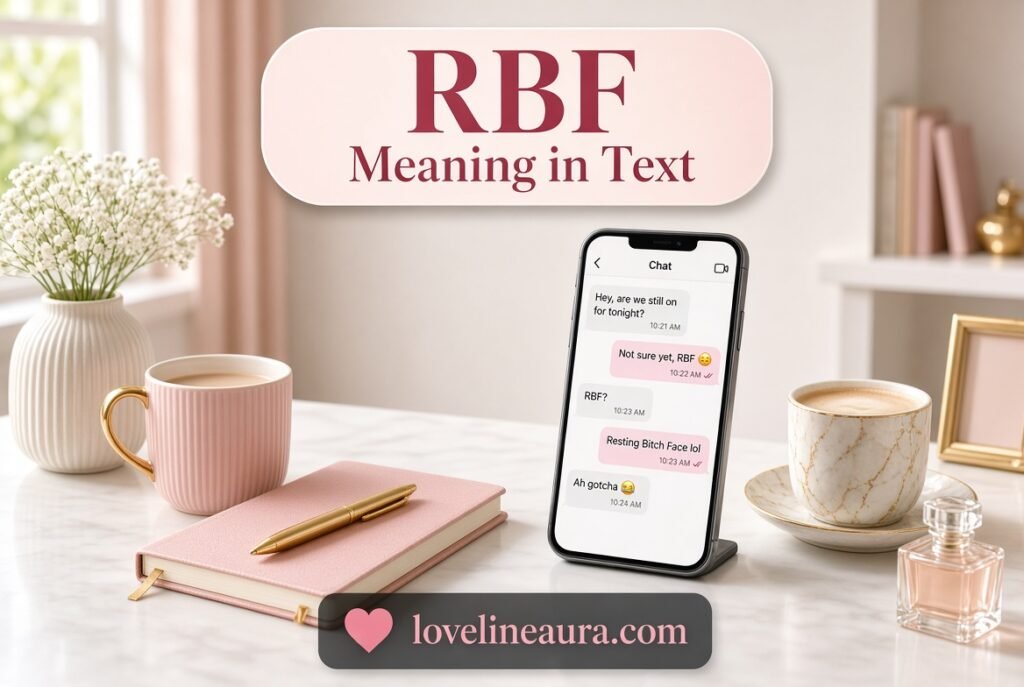

If you’ve seen RBF meaning in text, it usually refers to resting bitch face, a popular internet abbreviation used in texting culture and social media slang. The RBF full form describes a neutral facial expression that may unintentionally appear serious, annoyed, angry, or unapproachable even when someone feels completely fine.
Understanding RBF slang requires attention to contextual meaning, because the phrase can be playful, self-descriptive, or an appearance comment depending on who uses it. In online communication, its meaning can also shift with tone and intent.
This guide explains what does RBF mean, how RBF in chats, RBF in texting, and RBF in social media are commonly used, and how to interpret the expression naturally. You’ll also see RBF examples that show how RBF context, social context, and conversational tone affect its meaning.
Because RBF can involve facial expression stereotypes, personality judgment, and gender expectations, it’s worth understanding the phrase before responding. Whether someone uses RBF as a joke, RBF as humor, or RBF as a label, the surrounding conversation usually provides the clearest clue.
Also Read This: BD Meaning in Text: What It Means, How to Use It, and How to Understand It
What Does RBF Mean in Text?
The most common RBF meaning in text is “resting b*tch face.” People use it when someone’s relaxed or neutral facial expression appears more irritated, stern, or unhappy than they actually feel.
Imagine someone sitting quietly while waiting for a friend. Their eyebrows may naturally sit low and their mouth may rest in a straight line. A stranger might assume they’re annoyed. In reality, they could simply be thinking about what to eat for dinner.
That’s the basic idea behind RBF.
The expression doesn’t necessarily describe someone’s personality. It also doesn’t prove that someone feels angry. Instead, it describes how a person’s neutral face appears to other people.
RBF Meaning at a Glance
| Term | Meaning |
| RBF | Resting b*tch face |
| Type | Informal slang |
| Common use | Texting, social media, casual conversations |
| Usually describes | A naturally serious-looking resting expression |
| Tone | Humorous, teasing, self-deprecating, or insulting |
| Formal writing | Generally inappropriate |
| Main caution | It can be offensive when directed at someone |
The key distinction is simple: RBF describes perceived appearance, not confirmed emotion.
What Does “You Have RBF” Mean?
When someone says, “You have RBF,” they usually mean your neutral facial expression looks serious, annoyed, or intimidating.
The comment can carry different meanings depending on who says it.
A close friend might say it while joking around. Someone posting a selfie might use the phrase about themselves. A stranger making the same comment could come across as unnecessarily judgmental.
For example:
“Everyone thinks I’m mad, but I’m literally just sitting here. RBF strikes again 😂”
Here, the speaker uses RBF humorously and refers to themselves.
Compare that with:
“Why do you always look so angry? You have RBF.”
That version can sound critical because the speaker is making an unsolicited comment about another person’s appearance.
What Is the Full Form of RBF in Texting?
The RBF full form in texting is “resting b*tch face.”
The phrase combines three ideas:
- Resting refers to a person’s normal expression when they’re not deliberately smiling or showing a particular emotion.
- B*tch is the profane part of the expression and contributes to its deliberately blunt tone.
- Face refers to the person’s facial expression.
Although the phrase is widely recognized in casual internet culture, it isn’t suitable for every situation. The profanity makes it especially risky in professional conversations, formal writing, or interactions with people you don’t know well.
A less offensive explanation would be:
- “You naturally look serious.”
- “Your neutral expression looks intense.”
- “You have a serious resting expression.”
These alternatives communicate the same general observation without the profanity.
What Does RBF Mean in Slang?
As slang, RBF describes a facial expression that looks annoyed or unfriendly while the person is actually neutral.
People often use it in humorous or self-aware ways. Someone might post an unfiltered selfie and write, “My RBF is working overtime today.” Another person might joke that their face makes them look intimidating before anyone gets to know them.
The term can also describe the gap between appearance and reality.
For example, someone might look stern while listening carefully. Their face says “don’t bother me,” while their actual thoughts say “that’s a really interesting story.”
That contrast makes RBF useful as internet humor.
However, the phrase isn’t automatically harmless. Since it comments on someone’s appearance and contains a gendered insult, it can easily offend someone when used without familiarity or tact.
Where Did the Term RBF Come From?
The phrase “resting b*tch face” developed as informal slang describing a facial expression that appears unpleasant or irritated during a neutral state.
The abbreviated form RBF became especially common online because abbreviations make longer phrases quicker to type. Internet communities, social media, memes, and popular culture helped push the expression into broader everyday vocabulary.
The exact origin of the phrase isn’t tied to one universally accepted inventor. Early internet usage helped establish the abbreviation before it became much more recognizable through social media and popular culture.
The phrase also gained attention through discussions about facial expressions, gender expectations, and how people interpret women’s appearances.
That history matters because RBF isn’t simply a neutral description. It can reflect how society judges people based on whether their resting expressions appear pleasant, approachable, or cheerful.
Why Do People Use RBF?
People use RBF for several different reasons. The surrounding conversation usually reveals the intended tone.
To Describe a Naturally Serious Expression
Some people simply have neutral expressions that look stern. Their face may appear irritated even when they’re completely relaxed.
RBF gives people a quick way to describe that experience.
As a Joke About Themselves
Self-directed humor is one of the most common uses.
Someone might upload a photo and caption it:
“Trying to look approachable, but my RBF had other plans.”
Because the person is talking about themselves, the phrase often feels less judgmental.
To Explain Why They Seem Unapproachable
Someone may use RBF to explain why strangers rarely start conversations with them.
For example:
“People think I’m mean until they talk to me. Apparently, I have RBF.”
The speaker isn’t necessarily claiming to be unfriendly. They’re explaining how others interpret their expression.
To Tease a Friend
Close friends sometimes use RBF as playful banter.
Still, familiarity matters. A joke that makes one friend laugh could make another person uncomfortable.
To Comment on Someone’s Appearance
This is where the term becomes more sensitive.
Telling someone they have RBF focuses attention on their face and can imply that their appearance is unpleasant. The speaker may intend humor, yet the listener may hear criticism.
RBF vs. Being Angry or Unfriendly
RBF and genuine anger aren’t the same thing.
| RBF | Actually Angry |
| Neutral expression appears irritated | Person genuinely feels angry |
| May happen while relaxing | Usually has an emotional cause |
| Doesn’t reveal personality | May influence behavior |
| Can be misread by others | Usually involves an actual negative mood |
| May disappear when the person speaks | Can remain alongside angry behavior |
This distinction is crucial.
Someone can look furious while thinking about vacation plans. Another person can smile warmly while secretly feeling frustrated.
Facial expressions provide clues, not perfect emotional transcripts.
How to Tell What RBF Means From Context
When you see RBF in text, don’t interpret the abbreviation in isolation.
Check these clues:
- Who wrote it? A close friend may be joking.
- Who are they describing? Self-use often sounds less confrontational.
- What came before it? A selfie or photo may explain the reference.
- Are there emojis? They can signal playful intent.
- What is the relationship? Familiarity changes how slang lands.
- Is the conversation professional? RBF is usually too informal.
- Does the message sound judgmental? That can indicate an insulting use.
Think of context as the missing half of the message. The abbreviation tells you the words. The surrounding conversation tells you the intent.
RBF Meaning in Different Contexts
| Context | Likely meaning | Typical tone |
| Text message | Resting b*tch face | Casual |
| Resting b*tch face | Playful or teasing | |
| Resting b*tch face | Humorous or self-aware | |
| TikTok | Resting b*tch face | Meme-like or playful |
| Snapchat | Resting b*tch face | Casual |
| Workplace chat | Potentially inappropriate slang | Depends on context |
| Formal writing | Usually unsuitable | Informal |
The same abbreviation can feel completely different depending on where it appears.
Is RBF Appropriate to Use?
RBF works best in informal conversations where everyone understands the tone.
Self-directed use is generally easier to interpret because the speaker controls the joke. Using it about someone else requires more care.
Avoid using it casually when:
- You barely know the person.
- You’re speaking in a professional setting.
- The person has expressed discomfort about appearance-based comments.
- You’re commenting publicly on someone’s appearance.
- The phrase could reinforce a negative judgment.
- You aren’t sure whether the person appreciates that type of humor.
A cleaner alternative can often accomplish the same thing.
Instead of saying:
“You have RBF.”
Try:
“You look really serious in that photo.”
Even better, if you’re genuinely concerned about their mood:
“Hey, are you okay?”
That question addresses the person’s actual feelings instead of guessing from their face.
A Quick Guide to RBF Meaning in Text
If you encounter RBF in a message and aren’t sure what it means, use this quick checklist:
- Is the conversation about someone’s face or appearance?
- Is someone discussing a selfie or photo?
- Does the message mention looking angry, serious, or intimidating?
- Is the speaker making a joke about themselves?
- Does the surrounding conversation feel casual?
- Could the abbreviation have another meaning in that particular community?
If several clues point toward facial expressions, RBF almost certainly means “resting b*tch face.”
Final Takeaway About RBF Meaning in Text
The most common RBF meaning in text is “resting b*tch face,” an informal phrase for a neutral facial expression that appears serious, annoyed, or unfriendly. You’ll commonly see it in texts, WhatsApp chats, Instagram captions, TikTok content, Snapchat conversations, memes, and casual social interactions.
The important part isn’t just knowing the full form. RBF doesn’t automatically mean someone is angry, rude, unhappy, or unfriendly. It describes how their resting expression may appear to other people.
When someone uses RBF about themselves, it often carries a humorous or self-aware tone. When someone uses it toward another person, the meaning can shift quickly from playful teasing to an unwanted appearance-based insult. Context is the deciding factor.
FAQs
What does RBF meaning in text actually mean?
RBF meaning in text refers to a resting facial expression that can make someone appear serious, annoyed, angry, or unapproachable even when they feel fine. The RBF full form is commonly used as internet slang and a texting abbreviation.
What is the RBF full form and RBF slang meaning?
The RBF full form is resting bitch face, a blunt slang term describing an unintentional expression that appears annoyed, serious, or bored. Its RBF slang meaning can vary depending on context and tone.
How is RBF used in texting and social media?
RBF in texting, RBF in social media, comments, and captions usually describes someone’s facial expression or serious look. It can be used as humor, a joke, or a casual label during online communication.
Does RBF mean someone is angry or annoyed?
Not necessarily. RBF and facial expressions can create a perceived emotion such as anger, annoyance, or boredom, even when someone feels content, at peace, or completely fine.
How should you respond to RBF in a conversation?
When responding to RBF, consider the conversational context, tone, and relationship before reacting. A simple response can clarify that your neutral appearance or resting expression does not reflect your actual mood.
Conclusion
Understanding RBF meaning in text makes it easier to recognize this common internet abbreviation in texting, social media, and online communication. The RBF full form and RBF slang meaning describe a resting facial expression, but they don’t automatically reveal someone’s mood, personality, or emotions. Always consider contextual meaning, tone and intent, and social context before interpreting a serious or annoyed look. Knowing how RBF in chats, comments, and captions works helps you understand modern slang without making unfair assumptions about someone’s appearance or identity.