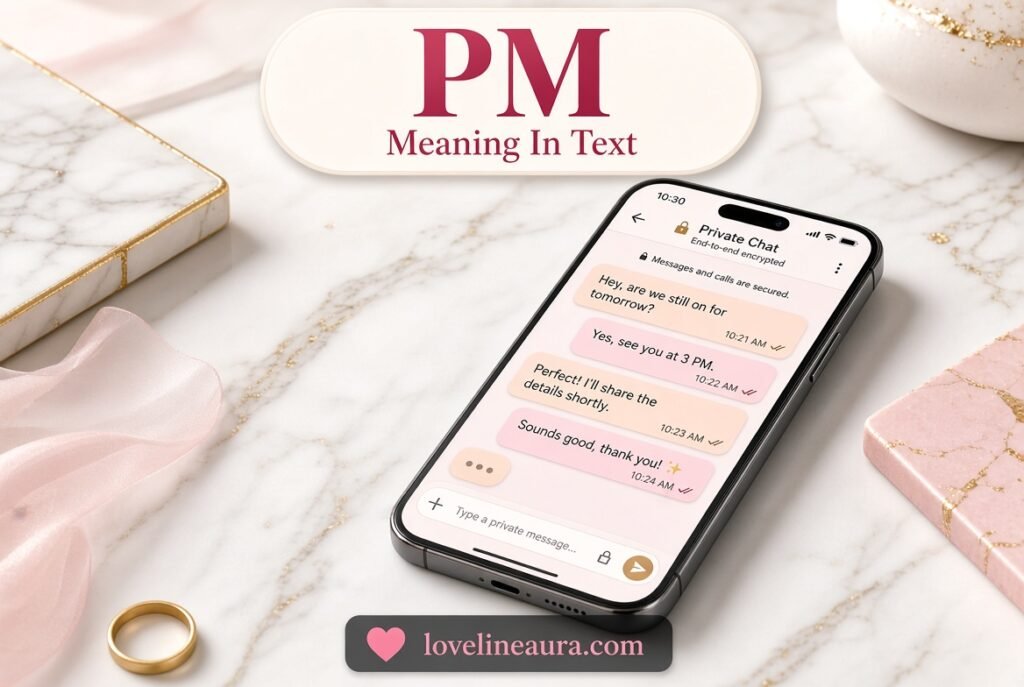

Understanding PM meaning in text can be confusing because the abbreviation has several common meanings. In digital communication, PM often means private message or direct message.
You may see PM me in online conversation, text messages, social platforms, and casual conversations. However, PM can also refer to Post Meridiem, especially when discussing time.
The meaning usually depends on the context and the words around the abbreviation. For example, PM me the details means someone wants a private message. Meanwhile, meet at 7 PM clearly refers to a time of day, specifically the evening.
This guide explains these multiple meanings, common uses, and practical examples so you can correctly understand PM in conversations.
Also Read This: Moots Meaning in Text: What It Means, How People Use It, and Real Examples
What Does PM Mean in Text?
The most common PM meaning in text is private message. It describes a message sent directly to one person rather than posted publicly where everyone can see it.
For example:
“PM me your address.”
This means:
“Send me your address in a private message.”
A PM can contain ordinary conversation, contact details, questions, files, offers, or other information that someone doesn’t want to share publicly.
The term became especially common through internet forums and online communities where users could post publicly while also communicating privately.
PM as “Private Message”
Private message is the clearest expansion of PM in most online conversations.
Imagine someone posts a question in a public community. Another person replies, “PM me and I’ll explain it.” The second person doesn’t want to continue the discussion publicly. Instead, they’re inviting the other person into a private conversation.
PM can therefore function as both a noun and a verb.
- Noun: “I sent you a PM.”
- Verb: “PM me when you’re available.”
- Instruction: “Please PM me the details.”
- Request: “Can you PM me?”
The exact wording changes, but the basic idea remains the same: move the conversation into a private channel.
What “PM Me” Means
When someone says “PM me,” they’re asking you to contact them privately.
For example:
- “PM me the price.”
- “PM me if you’re interested.”
- “PM me your username.”
- “PM me when you get home.”
- “PM me for more information.”
The phrase doesn’t necessarily suggest secrecy or anything suspicious. In many situations, it simply means the person doesn’t want to clutter a public conversation with personal details.
Quick Examples of PM in Text
| Text | Meaning |
| “PM me the details.” | Send the details privately. |
| “I’ll PM you later.” | I’ll send you a private message later. |
| “Did you get my PM?” | Did you receive my private message? |
| “PM me if you want one.” | Contact me privately if you’re interested. |
| “Check your PMs.” | Look at your private messages. |
Context makes the meaning easy to recognize in most cases.
PM Full Form in Texting
The most common PM full form in texting is Private Message.
Some people also use PM to mean personal message. The two expressions are closely related because both describe a direct message intended for an individual rather than a public audience.
Still, private message is the more established expansion in online communication.
Here’s an easy comparison:
| Abbreviation | Common meaning | Typical context |
| PM | Private Message | Forums, chats, online communities |
| DM | Direct Message | Social media and messaging platforms |
| p.m. | Post meridiem | Time |
| PM | Prime Minister | Politics and news |
| PM | Project Manager | Workplace conversations |
This is why the phrase surrounding PM matters so much.
“PM me” almost certainly concerns messaging.
“Meet me at 8 PM” clearly concerns time.
What Does PM Mean in Online Chat?
In online chat, PM meaning usually points to a private conversation between users.
The concept is simple. A public comment can be seen by many people while a PM goes directly to the intended recipient or a private conversation space.
For example, imagine a gaming community where someone asks:
“Does anyone know where I can find this item?”
Another user might respond:
“PM me. I know where to get it.”
The responder is telling the person to start a private conversation.
PMs can serve many purposes, including:
- Asking personal questions
- Sharing contact information
- Discussing private details
- Negotiating a sale
- Continuing a public discussion privately
- Sending additional information
- Sharing files or resources
- Coordinating plans
PM vs. Public Comment
A useful way to understand PM is to compare it with a public comment.
A public comment is like speaking through a microphone in a crowded room. Everyone nearby can hear it.
A PM is more like stepping aside and having a one-on-one conversation.
That difference explains why people often say “PM me” when personal information is involved.
PM Meaning on WhatsApp
On WhatsApp, PM can still mean private message, but the platform generally refers to individual conversations simply as chats or messages.
For example, someone might say:
“PM me your location.”
On WhatsApp, that normally means:
“Send me your location in a private chat.”
However, using PM isn’t necessary because WhatsApp already provides direct conversations.
You might therefore see people use PM casually even when they could simply say:
- “Message me.”
- “Text me.”
- “Send it to me privately.”
- “DM me.”
The intended meaning depends on the speaker’s communication habits.
A WhatsApp Example
Person A: “I have the document you need.”
Person B: “Great. PM me when you can.”
Here, PM simply means sending the document through a private conversation rather than posting it in a group.
PM Meaning on Instagram
The PM meaning on Instagram usually refers to sending someone a private message. However, DM, meaning direct message, is much more closely associated with Instagram’s terminology.
Someone might write:
“PM me for the details.”
They’re essentially asking you to contact them privately through Instagram.
You may also hear:
“Send me a DM.”
In practical terms, both requests can lead to the same action.
PM vs. DM on Instagram
| Term | Meaning | Commonness on Instagram |
| PM | Private message | Understandable but less platform-specific |
| DM | Direct message | Very common |
| Message | Send a private message | Extremely natural |
So, if someone says “PM me on Instagram,” there’s usually little mystery. They want a private conversation.
PM vs. DM: What’s the Difference?
PM and DM often describe essentially the same type of private online communication.
The main difference comes from terminology and platform culture.
PM stands for private message. It became strongly associated with forums, online communities, and older messaging systems.
DM stands for direct message. Social platforms popularized this wording and made it part of everyday internet vocabulary.
For example:
- “PM me” = Send me a private message.
- “DM me” = Send me a direct message.
- “Check your PMs” = Check your private messages.
- “Check your DMs” = Check your direct messages.
The action is often practically identical.
PM Meaning When Talking About Time
Here’s where things can get confusing.
PM doesn’t always mean private message.
When written after a clock time, PM or p.m. means post meridiem, a Latin phrase meaning after midday.
The 12-hour clock divides the day into two 12-hour periods:
- AM: Before noon
- PM: After noon
Therefore:
- 1 PM = one hour after noon
- 5 PM = late afternoon
- 8 PM = evening
- 11 PM = late evening
Consider these two sentences:
“PM me the photos.”
Here, PM means private message.
“Send the photos at 8 PM.”
Here, PM refers to time.
The surrounding words solve the mystery.
An Important Time Fact
The exact midpoint of the day is 12:00 PM, while midnight is 12:00 AM in conventional 12-hour notation.
Because people sometimes confuse these two labels, using noon and midnight can make schedules clearer.
Is PM Still Popular?
Yes, PM is still understood and used online, especially in communities that use the phrase “private message.”
However, the popularity of DM has grown substantially because major social platforms use direct-message terminology.
That doesn’t make PM incorrect.
Instead, the preferred abbreviation often depends on the platform and audience.
Someone active on forums might naturally say:
“Send me a PM.”
Someone who spends most of their time on social media might say:
“Send me a DM.”
Both phrases can communicate essentially the same request.
PM in Modern Online Slang
PM isn’t really slang in the same way as highly expressive internet abbreviations. It’s better described as practical online shorthand.
Still, it appears in informal phrases such as:
- “PM me.”
- “Check your PMs.”
- “Slide into my PMs.”
- “I sent you a PM.”
- “Just PM me.”
The phrase “slide into my PMs” adds a playful tone to the ordinary act of sending a private message.
In many cases, PM feels more functional than trendy. It tells someone where or how to continue a conversation.
Common Mistakes When Using PM
A few simple mistakes can make a message confusing.
Confusing PM with DM
PM and DM often overlap. However, some platforms strongly favor one term.
If you’re talking about Instagram, DM will usually sound more natural.
Confusing PM with p.m.
“PM me” and “5 PM” look similar but mean completely different things.
Compare:
“PM me after work.”
Private message.
“Call me at 5 PM.”
Time.
Assuming Every Platform Uses PM
Not every service calls private conversations PMs. Some use DMs, chats, inboxes, or messages.
Using the platform’s familiar terminology can make communication smoother.
Ignoring Context
This is the biggest mistake.
Don’t automatically translate every PM as “private message.” Look at the sentence first.
Tips for Using PM Correctly
If you want to use PM meaning in text correctly, keep these practical tips in mind:
- Use PM me when asking someone to message you privately.
- Use p.m. when referring to a time after noon.
- Use DM when discussing platforms where direct messaging is the standard term.
- Add context if PM could have multiple meanings.
- Consider your audience before using unfamiliar abbreviations.
- Don’t assume PM always means private message.
- Use noon or midnight when a time could be misunderstood.
- Keep private conversations private when they involve personal information.
Quick Reference
| Phrase | Correct interpretation |
| “PM me.” | Send me a private message. |
| “Check your PMs.” | Check your private messages. |
| “I sent you a PM.” | I sent you a private message. |
| “Meet at 6 PM.” | Meet at 6 in the evening. |
| “The PM gave a speech.” | Usually Prime Minister in political context. |
| “Ask the PM.” | Could mean Project Manager in workplace context. |
FAQs
What does PM meaning in text usually mean?
PM meaning in text usually refers to a private message or direct message in digital communication. The exact meaning depends on the context, especially in online chats, forums, and social platforms.
What does PM me mean in an online conversation?
PM me means asking someone to send a private message instead of posting publicly. It is common in text messages, private messaging, and casual conversations.
What does PM mean when talking about time?
When discussing time, PM means Post Meridiem, referring to the period after 12 noon. For example, meet at 7 PM means meet at seven in the evening.
Why can PM have multiple meanings in text messages?
PM is a common abbreviation used for different purposes in digital communication. It can describe private messaging, time of day, or professional roles depending on the context.
How can I correctly understand PM in conversations?
Look at the surrounding words, conversation, and context before interpreting PM. In online chats, it often means private message, while schedules usually indicate a time reference.
Conclusion
Understanding PM meaning in text starts with checking the context of the online conversation. In digital communication, PM commonly means private message, while Post Meridiem identifies a time reference after noon. Knowing these multiple meanings helps you interpret PM me, text messages, and online chats more confidently. When you consider the surrounding words and situation, you can correctly understand PM in conversations and avoid common misunderstandings.