
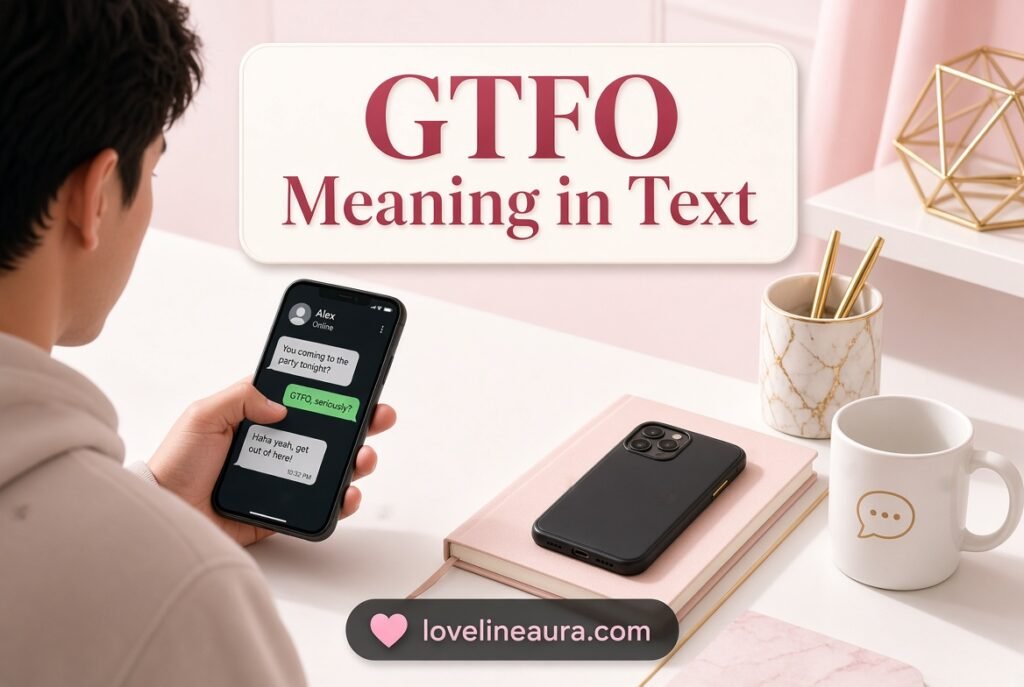

Understanding GTFO meaning in text can be tricky because its tone changes with context and relationships. GTFO meaning comes from get the f*ck out, a vulgar phrase often used as a forceful command. In text messages, online chats, and social media, it can express surprise, disbelief, shock, annoyance, or anger.
Its meaning depends heavily on the surrounding message, conversation context, and conversational tone. As a texting abbreviation and internet slang initialism, GTFO appears across group chats, DMs, gaming messages, and online conversations.
Sometimes friends use it as a playful expression or funny reaction, but it can also sound rude, aggressive, or insulting. Learning the full meaning, common GTFO usage, and situations when to avoid GTFO helps you interpret messages correctly. This guide explains its meanings, tones, examples, and appropriate responses clearly.
Also Read This: STTM Meaning in Text: What It Means, How to Use It, and Real Examples
What Does GTFO Mean in Text?
GTFO usually means “get the f*ck out.” In its most literal sense, someone uses it to tell another person to leave. However, texting has given the abbreviation another popular use: expressing strong surprise or disbelief.
For example, imagine a friend tells you they won a free vacation. You might reply:
“GTFO 😂 You’re serious?”
Here, the sender probably isn’t telling the friend to leave. Instead, GTFO means something closer to “No way!” or “You’re kidding!”
On the other hand, consider:
“GTFO of my room right now.”
That message is much more direct. The sender wants someone to leave and sounds genuinely angry.
So, the GTFO meaning in text isn’t determined by the abbreviation alone. The surrounding words provide the real clue.
GTFO Short Meaning
The simplest definition is:
GTFO = Get the f*ck out
Depending on context, it can also communicate:
- Leave immediately
- Go away
- Stop bothering me
- No way!
- You’re kidding!
- I can’t believe that!
- That’s unbelievable!
The expression is generally considered vulgar slang, so it isn’t suitable for every conversation.
GTFO in a Text Message
Texting removes facial expressions and vocal tone. That creates room for misunderstanding.
For instance, “GTFO 😂” may sound playful between close friends. Meanwhile, “GTFO.” can feel much harsher because the period and lack of additional context make the message look serious.
A useful rule is simple: don’t interpret GTFO in isolation.
Look at:
- What was said immediately before it
- Who sent the message
- Your relationship with that person
- Whether emojis appear
- Whether the conversation was already tense
- Whether the sender adds words such as “right now” or “seriously”
What Is the Full Form of GTFO?
The GTFO full form is “get the f*ck out.”
Each part represents a word:
| Letter | Represents |
| G | Get |
| T | The |
| F | F*ck |
| O | Out |
The abbreviation became useful because internet conversations often favor short, quick expressions. Instead of typing the entire phrase, people can use four letters to communicate the same idea instantly.
However, shortening the phrase doesn’t remove its vulgar nature. GTFO remains profanity-based slang, even though many people recognize it immediately.
The phrase can also appear in variations such as GTFOH, which generally means “get the f*ck outta here.” That version often emphasizes disbelief or dismissal.
What Does GTFO Mean as Slang?
The GTFO slang meaning depends heavily on how someone uses it. It can be hostile, humorous, surprised, dismissive, or playful.
Telling Someone to Leave
This is the most direct interpretation.
Someone might say:
“GTFO of here before this gets worse.”
In this situation, the abbreviation functions as a forceful command. The sender wants the other person to leave.
Because the phrase contains profanity, it sounds much stronger than:
- Please leave.
- Go away.
- Could you leave?
- I need you to step outside.
If someone sends GTFO during an argument, it usually carries a much more aggressive tone.
Showing Shock or Disbelief
One of the most interesting uses of GTFO happens when someone isn’t actually angry.
Suppose your friend says:
“I just met my favorite actor at the airport.”
You might respond:
“GTFO! 😭 That actually happened?”
Here, the phrase expresses disbelief and excitement. It works similarly to “No way!” or “You’re kidding!”
This usage is especially common among friends who already understand each other’s humor.
Expressing Annoyance or Frustration
GTFO can also show irritation.
For example:
“You’re still blaming me for that? GTFO.”
The sender isn’t necessarily asking someone to physically leave. Instead, they’re rejecting what the other person said in a forceful way.
This use is more confrontational than playful disbelief.
Playful Banter Between Friends
Close friends sometimes use strong slang without intending genuine hostility.
For example:
“I finished the entire pizza before you got here.”
“GTFO 😂”
The second person may simply be joking about the claim.
That doesn’t mean GTFO is universally harmless. A joke works only when both people understand the relationship and tone. What one friend considers funny might sound insulting to someone else.
Polite Alternatives to GTFO
If the goal is to communicate the same general idea without profanity, several alternatives work well.
When You Mean “No Way!”
Use:
- No way!
- You’re kidding!
- Seriously?
- That’s unbelievable!
- Are you serious?
- You can’t be serious!
- Wait, what?!
These options preserve the surprise without using profanity.
When You Mean “Please Leave”
Try:
- Please leave.
- Could you step outside?
- I need some space.
- Please give me a moment.
- I’d like you to leave now.
- Can we have some distance?
The best choice depends on how firm you need to be.
Respectful Responses During an Argument
Instead of escalating with GTFO, you can say:
- Let’s take a break.
- I don’t want to argue right now.
- Please give me some space.
- We can discuss this later.
- Let’s calm down before continuing.
These phrases establish boundaries without adding unnecessary heat.
GTFO vs. Similar Slang Terms
GTFO belongs to a broader family of internet abbreviations. Some look similar but serve different purposes.
| Slang | Meaning | Common use |
| GTFO | Get the f*ck out | Telling someone to leave or expressing disbelief |
| GTFOH | Get the f*ck outta here | Disbelief, dismissal, or rejection |
| STFU | Shut the f*ck up | Telling someone to stop talking |
| WTF | What the f*ck | Shock, confusion, or frustration |
| OMG | Oh my God | Surprise or excitement |
| LOL | Laughing out loud | Amusement |
| SMH | Shaking my head | Disapproval or disbelief |
These abbreviations shouldn’t be treated as interchangeable.
For example, WTF usually expresses confusion or shock. GTFO can express disbelief but also carries the additional idea of leaving or rejection.
Is GTFO Still Popular?
GTFO remains recognizable in modern internet communication. People still encounter it across texting, social media, gaming, memes, and casual online conversations.
However, being recognizable doesn’t mean it’s appropriate everywhere.
Internet slang changes quickly. Some abbreviations disappear from everyday use while others remain recognizable for years because they communicate a strong emotion efficiently. GTFO belongs to the latter group.
Its continued recognition also comes from its versatility. Four letters can communicate surprise, dismissal, frustration, disbelief, or a literal demand to leave.
GTFO in Gen Z and Online Slang Culture
Modern online conversations often favor compressed language, humor, exaggeration, and reaction-based communication. GTFO fits naturally into that environment.
Still, it shouldn’t be treated as exclusively Gen Z slang. The abbreviation has been used across internet communities for years and can appear among people from different age groups.
GTFO Among Friends
Friends may use GTFO as playful banter.
For example:
“I finished the entire assignment in twenty minutes.”
“GTFO 😂”
The response may simply mean, “I don’t believe you!”
Shared history makes this kind of humor easier to understand.
GTFO in Family Chats
Family conversations are more complicated.
Some families casually use strong slang with one another. Others consider profanity disrespectful. Therefore, the relationship and household communication style matter.
A message such as “GTFO 😂” between siblings might be harmless teasing. The same wording toward an older relative could easily come across as disrespectful.
GTFO in Gaming
Gaming provides plenty of situations where GTFO appears naturally.
Players may use it for:
- Competitive banter
- Quick commands
- Frustrated reactions
- Jokes after winning
- Reactions to unexpected plays
Tone remains important because competitive environments can make even ordinary slang sound hostile.
GTFO at School
Students may encounter GTFO in group chats, gaming conversations, social platforms, or text messages.
Using it with friends is one thing. Directing profanity toward teachers, staff, or classmates during conflict is another.
The setting matters just as much as the meaning.
GTFO on Social Media
Social platforms make exaggerated language particularly common.
A comment such as:
“GTFO 😂 This is wild.”
may simply communicate disbelief.
However, directed at another user during an argument, the same abbreviation can become confrontational.
The safest approach is to read the surrounding conversation before assigning a tone.
Common Misunderstandings About GTFO
Several mistakes can lead to incorrect interpretations.
- GTFO doesn’t always mean someone literally wants you to leave.
- GTFO isn’t automatically friendly because a friend used it.
- GTFO isn’t automatically hostile when someone uses it after surprising news.
- Capital letters don’t determine the meaning by themselves.
- An emoji can suggest tone but doesn’t guarantee intent.
- The relationship between the sender and recipient matters.
- The surrounding conversation provides the strongest clue.
Think of GTFO as a phrase with two lanes. One lane points toward “leave” while the other points toward “no way.” Context tells you which lane the conversation has taken.
Quick Facts About GTFO
| Fact | Explanation |
| Full form | Get the f*ck out |
| Category | Internet and texting slang |
| Main literal meaning | Telling someone to leave |
| Common informal meaning | Expressing disbelief or surprise |
| Tone | Can range from playful to aggressive |
| Profanity level | Vulgar |
| Common platforms | Texting, social media, gaming, online chats |
| Best used with | People who understand the intended humor |
| Best avoided in | Formal and professional communication |
FAQs
What does GTFO meaning in text actually mean?
GTFO meaning in text usually refers to get the f*ck out, a texting abbreviation and internet slang initialism. Depending on the context, it can mean telling someone to leave or express surprise, disbelief, or shock.
Is GTFO considered rude or offensive in online chats?
Yes, GTFO is generally vulgar language and can sound rude, aggressive, or insulting. Its tone depends on the conversation context, relationship, and surrounding message.
How do people use GTFO in text messages and social media?
People use GTFO in text messages, social media, group chats, and gaming messages as a strong reaction. Friends may use it as a playful expression, funny reaction, or response to surprising news.
Can GTFO express surprise instead of telling someone to leave?
Yes, GTFO usage can express extreme shock, astonishment, or disbelief rather than a forceful command. In casual online conversations, the surrounding message context helps determine the intended meaning.
When should you avoid using GTFO?
You should avoid GTFO in professional communication, unfamiliar conversations, or situations where rude language may offend someone. Consider the tone, relationship, and context before responding to avoid misunderstandings.
Conclusion
Understanding GTFO meaning, GTFO usage, and GTFO context helps you interpret online messages more accurately. This internet slang initialism can signal disbelief, shock, annoyance, or a forceful command, depending on the conversation context and tone. While friends may use GTFO as a playful expression, its vulgar language can sound rude, aggressive, or insulting. Always consider the relationship and situation before using this popular texting abbreviation in online communication.