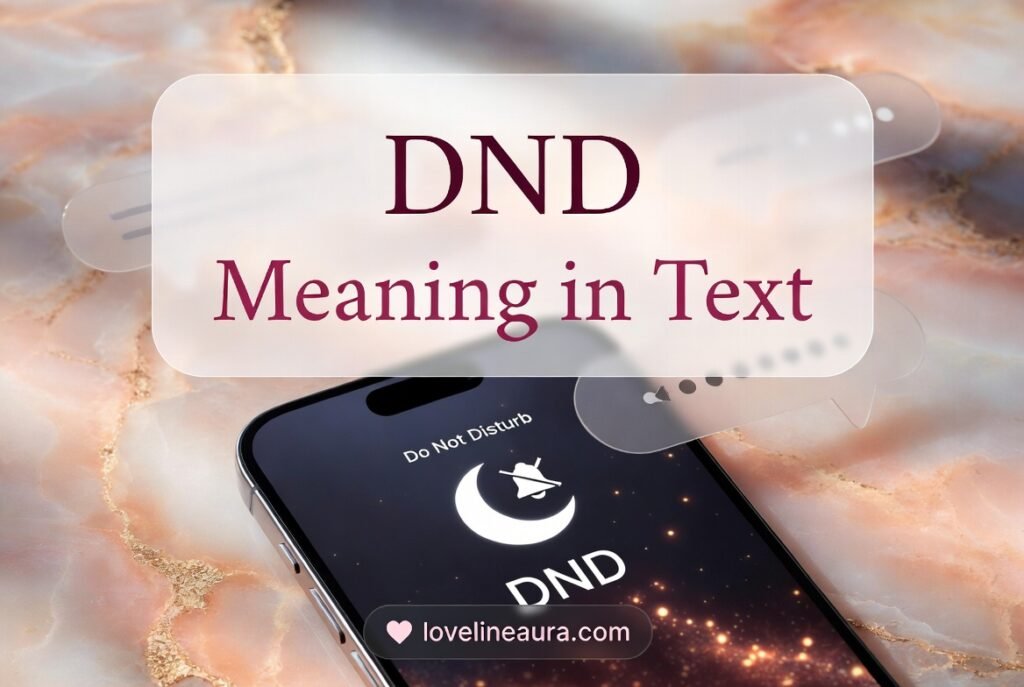

Understanding DND meaning in text helps you avoid confusion during everyday digital communication and online messaging. DND stands for Do Not Disturb, a popular texting abbreviation, text abbreviation, chat abbreviation, and internet slang.
People commonly use this common acronym across messaging apps, online chat, and every chat platform. Learning its real meaning, abbreviation meaning, and acronym meaning improves communication style, message interpretation, and conversation context.
Whether someone is busy at work, sleeping, driving, studying, or enjoying alone time, Do Not Disturb mode signals they are unavailable without not ignoring you. Understanding DND in chat, DND in messages, DND on status, reply to DND, how to respond, and read correctly prevents misunderstandings and supports better communication etiquette.
This practical texting guide explains texting examples, real conversations, messaging behavior, notification settings, phone notifications, privacy settings, and setting boundaries for respectful social communication in today’s digital world.
Also Read This: WYF Meaning in Text: What It Means, How People Use It, and How to Reply
What Does DND Mean in Text?
The most common DND meaning in text is Do Not Disturb. People use it to say they do not want calls, messages, alerts, or interruptions right now. It is a short way to protect time, attention, or rest.
You may see it in a text like this:
- “I’m on DND till noon.”
- “Put me on DND. I’m in a meeting.”
- “DND for the next few hours.”
In each case, the message is clear. The sender is unavailable, and they want that respected.
What DND Usually Communicates
DND can mean different things at a glance, but the core idea stays the same:
- The person is busy
- The person needs quiet
- The person wants fewer interruptions
- The person is setting a temporary boundary
A lot of people assume DND is rude. It usually is not. In most cases, it is simply practical.
“DND is less about distance and more about timing.”
That is the heart of it. It is not always personal. Often, it is just about focus.
What Does DND Stand For?
DND stands for Do Not Disturb. The phrase has been around for years in phones, hotel doors, office spaces, and messaging apps. Texting just made it shorter and easier to use.
Today, DND shows up in many places:
- Text messages
- Social media bios
- Phone status settings
- Workplace chat apps
- Gaming profiles
The phrase has stayed popular because it is direct. You do not need a long explanation when a short one works.
When People Use DND in Text Messages
People usually use DND in text when they want to protect their time or attention. The context often tells you why.
Common real-life situations
- During meetings
Someone may text, “I’m on DND in meetings all morning,” to avoid interruptions. - While sleeping
A person might say, “DND after 11 p.m.” because they do not want late-night messages. - When studying or working
Students and professionals use it when they need focus. - When driving
Safety matters here. A DND message can mean no texting until later. - During personal time
Some people use DND to create space for family, rest, or mental reset.
This is why context matters so much. The same abbreviation can mean “I need quiet” in one chat and “I am unavailable for hours” in another.
How DND Is Used Across Different Platforms
DND does not belong to one app. People use it across almost every major messaging platform. Still, the tone can shift a little depending on the app.
| Platform | Typical DND Use | What It Usually Means |
| SMS / iMessage | Personal text updates | Busy, sleeping, unavailable |
| Quick status or chat message | Do not message right now | |
| Bio, story, or DM | Taking a break from replies | |
| Snapchat | Casual chat context | Not active or not responding |
| Discord | Server or profile status | Focus mode or away from chat |
| Slack | Work communication | Do not interrupt unless urgent |
| Microsoft Teams | Professional status | In a meeting, focusing, offline |
On work apps like Slack or Teams, DND can feel more formal. On social apps like Instagram or Snapchat, it can feel more casual or even playful.
DND Meaning in Social Media
On social media, DND meaning in text often goes beyond the literal phrase. People use it as part of their online identity.
You might see it in:
- Bios
- Captions
- Story posts
- Direct messages
- Comment replies
For example, someone might write:
- “Currently on DND, catching peace only.”
- “DND mode today.”
- “In my DND era.”
That last one is especially common online. It does not always mean total silence. Sometimes it just means the person wants less noise and more control over their time.
Social media has also made DND feel a little more expressive. It can sound serious, funny, dramatic, or even stylish. The meaning stays simple, but the tone changes.
DND Meaning in Online Communities and Gaming
In online communities and gaming, DND usually still means Do Not Disturb. Players and community members use it when they are:
- In a match
- Focused on a task
- Away from the keyboard
- Not taking messages
- Avoiding distractions
Gamers often set status indicators so teammates know when they can and cannot respond. That keeps communication smoother and prevents confusion.
A gaming example might look like this:
- “DND for ranked matches”
- “On DND. Back after this raid.”
- “Need DND mode for the next hour.”
This is practical, not personal. It helps people avoid wasted pings and half-finished conversations.
DND in Professional Communication
In professional settings, DND can be especially useful. It shows that someone is busy, but it also tells others how to behave.
Why professionals use DND
- To protect meeting time
- To reduce message overload
- To stay focused on deep work
- To signal availability clearly
- To reduce unnecessary interruptions
In a workplace, “DND” can mean “Do not contact me unless it is urgent.” That is helpful when people need to finish reports, attend calls, or handle deadlines.
Best practices at work
- Use DND status during meetings
- Add a return time if possible
- Check urgent channels only when needed
- Respect other people’s DND settings
- Do not treat DND as a permanent wall
A DND status works best when people understand it is temporary. That makes it polite and productive.
Hidden or Misinterpreted Meanings of DND
Most of the time, DND means Do Not Disturb. Still, people sometimes misread it.
Common misunderstandings
- They are ignoring me.
Not necessarily. They may just be busy. - They blocked me.
DND is not the same as blocking. - They are upset with me.
Maybe not. They may need quiet for unrelated reasons. - They are unavailable forever.
Usually not. DND is often temporary.
The safest approach is to read the surrounding message. If someone says, “I’m on DND till 5,” they are giving a time frame. That is usually a sign of routine, not conflict.
DND vs Similar Texting Terms
A lot of abbreviations look similar, but they do different jobs. Here is a simple comparison.
| Term | Meaning | Main Use |
| DND | Do Not Disturb | Avoid interruptions |
| AFK | Away From Keyboard | Not actively present |
| BRB | Be Right Back | Temporary pause |
| OOO | Out of Office | Work-related absence |
| Mute | Silence notifications | Stop alerts without blocking |
| Focus mode | Concentration setting | Reduce distractions |
DND is often broader than AFK or BRB. AFK suggests the person is away. BRB suggests they will return soon. DND simply says, “Do not disturb me right now.”
How to Respond When Someone Says DND
Your reply should match the relationship and the situation. A good response is brief, respectful, and calm.
Good replies
- “Got it.”
- “No problem.”
- “I’ll reach out later.”
- “Sounds good. Focus on what you need.”
- “Understood. Message me when you’re free.”
What to avoid
- Pushing for attention
- Asking repeated questions
- Taking it personally
- Sending too many follow-ups
If the person is at work, keep your reply professional. If it is a friend, you can sound warmer. The key is to respect the boundary they set.
Real Examples of DND in Text
Here are a few realistic examples that show how the phrase works in everyday conversation.
Casual text
Person A: Are you free to talk?
Person B: Not right now. DND till after dinner.
Work chat
Manager: Can you review this document?
Employee: I’m on DND for the next meeting block. I’ll check it after 3.
Friend chat
Friend: Why aren’t you replying?
Friend 2: On DND. Needed a break from my phone.
Relationship chat
Partner: Want to call later?
Partner 2: Sure. I’m DND for a bit but I’ll text you soon.
These examples show something important: DND does not always shut communication down. It just slows it down.
Case Study: Why DND Prevents Misunderstanding
Imagine two coworkers. One sends a message at 9:00 a.m. The other does not reply for two hours. Without context, the first coworker may think the second person is ignoring them.
Now imagine the second coworker had written, “On DND until 11 because I’m in back-to-back meetings.” That small message changes everything. It removes doubt, reduces stress, and sets expectations.
That is the real value of DND in text. It prevents the awkward gap between silence and assumption.
A Simple Rule for Reading DND Correctly
When you see DND meaning in text, ask three quick questions:
- Who sent it?
- Where did they send it?
- What is the situation?
If a friend sends it casually, it may just mean they need space. If a coworker sends it in Slack, it probably means they are in a meeting. If someone uses it in a bio, it may mean they are not taking messages for now.
Context turns a short abbreviation into a clear message.
Why DND Still Matters
People are more connected than ever, but they are also more overloaded than ever. DND gives them a simple way to say, “I need a pause.”
That matters because attention is valuable. So is rest. So is focus. DND helps people protect all three without writing a long explanation every time.
It works because it is short, direct, and widely understood. That makes it one of the most useful text abbreviations in modern communication.
FAQs
What is DND meaning in text and what does DND stand for?
DND meaning in text refers to Do Not Disturb, a popular texting abbreviation, text slang, and internet slang used in digital communication. It tells others that a person is temporarily unavailable, helping reduce interruptions during online conversation or social messaging.
How is DND used in text message and messaging apps?
People use DND in a text message, messaging apps, and online chat to show they cannot reply immediately. It often appears as a status message, chat status, or unavailable status, making communication etiquette clearer and reducing misunderstandings.
When should you reply to DND in an online conversation?
The best reply to DND depends on the conversation context and message tone. If someone is busy at work, driving, studying, or sleeping, wait for a response instead of sending repeated messages, respecting their communication preferences.
Does Do Not Disturb mode block messages or only phone notifications?
Do Not Disturb mode mainly silences phone notifications through notification settings and privacy settings on a smartphone or mobile phone. It does not usually stop a text message from arriving, but it delays alerts until the user checks them.
How can you read correctly the meaning of DND in chat or DND on status?
To read correctly DND in chat or DND on status, pay attention to context clues, communication style, and the ongoing conversation context. Understanding the real meaning of this common acronym helps avoid awkward situations, supports setting boundaries, and improves social communication.
Conclusion
Understanding DND meaning in text helps you confidently recognize DND as Do Not Disturb and interpret it correctly in any online conversation or text message. By considering conversation context, message tone, and communication style, you can read correctly every situation, avoid misunderstandings, and respond with proper communication etiquette. Whether used in messaging apps, online chat, or everyday digital communication, this common texting abbreviation supports setting boundaries, respecting communication preferences, and creating better social communication in today’s digital world.